• Extra Block One (Left):
     

    Hedge Height Reduction in Langford


    Tall hedges can provide excellent privacy but may eventually become difficult to maintain. They can also create excessive shade or begin to dominate smaller gardens. Hedge height reduction in Langford can bring an established hedge back to a more manageable level while retaining its screening function where possible.


    For very large hedges, the best approach may depend on how much living foliage would remain after the reduction. Once the required height has been established, regular maintenance can help prevent the hedge gradually returning to its previous dimensions.

    Hedges for Privacy & Screening


    Privacy is one of the main reasons homeowners choose hedging rather than a conventional fence. A dense hedge can soften the appearance of a boundary while providing natural screening between neighbouring gardens or between a property and the road. Good hedge maintenance aims to control size without unnecessarily sacrificing that screening.


    Regular trimming can encourage dense growth and help prevent a hedge becoming excessively wide. If you are considering creating additional natural screening rather than simply maintaining an existing hedge, our tree planting services in Langford can also help with the selection of appropriate trees for privacy.


    Boundary Hedge Trimming


    Boundary hedges often need to perform several jobs at once. They may provide privacy, mark the edge of a property and contribute significantly to the appearance of both the garden and surrounding street. As they grow, however, branches can begin to extend across neighbouring land, pavements, driveways and other access routes. Routine trimming helps maintain a defined boundary while preventing the hedge gradually occupying more space each year. For larger boundary hedges, professional equipment also allows the top and sides to be maintained more safely and consistently.


    Conifer Hedge Cutting


    Conifers are popular hedging plants because many varieties provide dense evergreen screening. Their vigorous growth can also make regular maintenance particularly important. Some commonly used conifers do not regenerate successfully when cut back into old brown wood. Allowing a conifer hedge to become substantially wider than required and then attempting a severe reduction can therefore leave permanent bare areas. Regular trimming of the green growth is usually a much better way to control its dimensions. If your conifer hedge has already become very large, Evolution Tree Works can assess how much reduction is practical.

    Laurel Hedge Trimming


    Laurel can create an effective evergreen boundary and is capable of producing vigorous growth once established. Without regular trimming, a laurel hedge can become both tall and exceptionally wide. Fortunately, established laurel can often respond well to appropriate pruning. Whether the hedge requires routine trimming or more substantial renovation will depend on its condition and the amount by which you want to reduce it. Once an overgrown hedge has been brought back to a suitable size, ongoing maintenance can help retain its shape and prevent the same problem developing again.

    Formal Hedge Cutting


    Formal hedges are maintained to create clearly defined lines and an even appearance. They can work particularly well beside entrances, paths, driveways and more structured garden designs. Maintaining this appearance generally requires more frequent attention than an informal hedge. Regular light trimming can help preserve the shape without repeatedly removing large amounts of growth. Evolution Tree Works can maintain formal hedging at domestic and commercial properties throughout Langford.


    Maintaining Natural & Informal Hedges


    Not every hedge needs perfectly straight sides and a flat top. Mixed and informal hedges can provide a softer, more natural boundary and may have particular value for wildlife. Maintenance can focus on controlling excessive growth and keeping the hedge appropriate for its location while preserving more of its natural character. The style of cutting should therefore reflect both the hedge species and the landscape in which it is growing.


    Clearing Paths & Driveways


    Hedges beside driveways and paths can gradually reduce the amount of usable space available. This may happen so slowly that the extent of the encroachment only becomes obvious when the hedge is eventually cut back. Overhanging vegetation can also reduce visibility around entrances and junctions. Appropriate side trimming can restore clearance while retaining the hedge itself. For large commercial properties, maintaining hedges around entrances, parking areas and pedestrian routes can also form an important part of routine grounds management.

    Hedge Trimming Near Roads & Pavements


    Where hedges grow beside roads and public footways, unmanaged growth can become more than an aesthetic issue. Branches may narrow the available pavement, obstruct visibility or make access more difficult. Regular maintenance helps keep vegetation within an appropriate boundary. Large roadside hedges can present additional practical challenges because work needs to take account of both the hedge itself and the surrounding area. Evolution Tree Works can assess the site and determine an appropriate method of carrying out the required work.

    Hedge Cutting & Nesting Birds


    Hedges provide important nesting and feeding habitat for many birds. This needs to be considered when planning hedge work. Active wild bird nests are legally protected, so hedges should be checked before cutting where nesting birds may be present. Where circumstances permit, more substantial reductions can be planned for a time that minimises disturbance to wildlife. If an active nest is discovered, work affecting it may need to be postponed until it is no longer in use.

     
  • Style: Image
  • Image:
  • Extra Block Two (Left):
     

    Commercial Hedge Trimming


    Evolution Tree Works provides commercial hedge trimming in Langford for businesses, landlords, property managers and other organisations. Well-maintained hedging can make an important contribution to the appearance of commercial premises while providing practical boundaries and screening.


    Our commercial hedge services can include:


    • Routine hedge cutting
    • Height reduction & Side trimming
    • Overgrown hedge renovation
    • Clearance around entrances and paths
    • Boundary hedge maintenance
    • Management of hedges around car parks and access roads


    Hedge work can also be incorporated into wider commercial tree services in Langford where trees and hedges across a property require ongoing management.

    Why Maintain Hedges Regularly?


    Routine maintenance can prevent many of the problems associated with mature hedges.


    Regular trimming can help:


    • Maintain a manageable height
    • Control the width of the hedge
    • Preserve privacy and screening
    • Encourage dense growth
    • Keep paths and driveways clear
    • Maintain visibility around entrances
    • Prevent a hedge overwhelming a smaller garden
    • Reduce the need for severe future pruning


    A little regular maintenance can often achieve a much better result than allowing a hedge to become excessively large before dealing with it.


    Professional Hedge Trimming in Langford


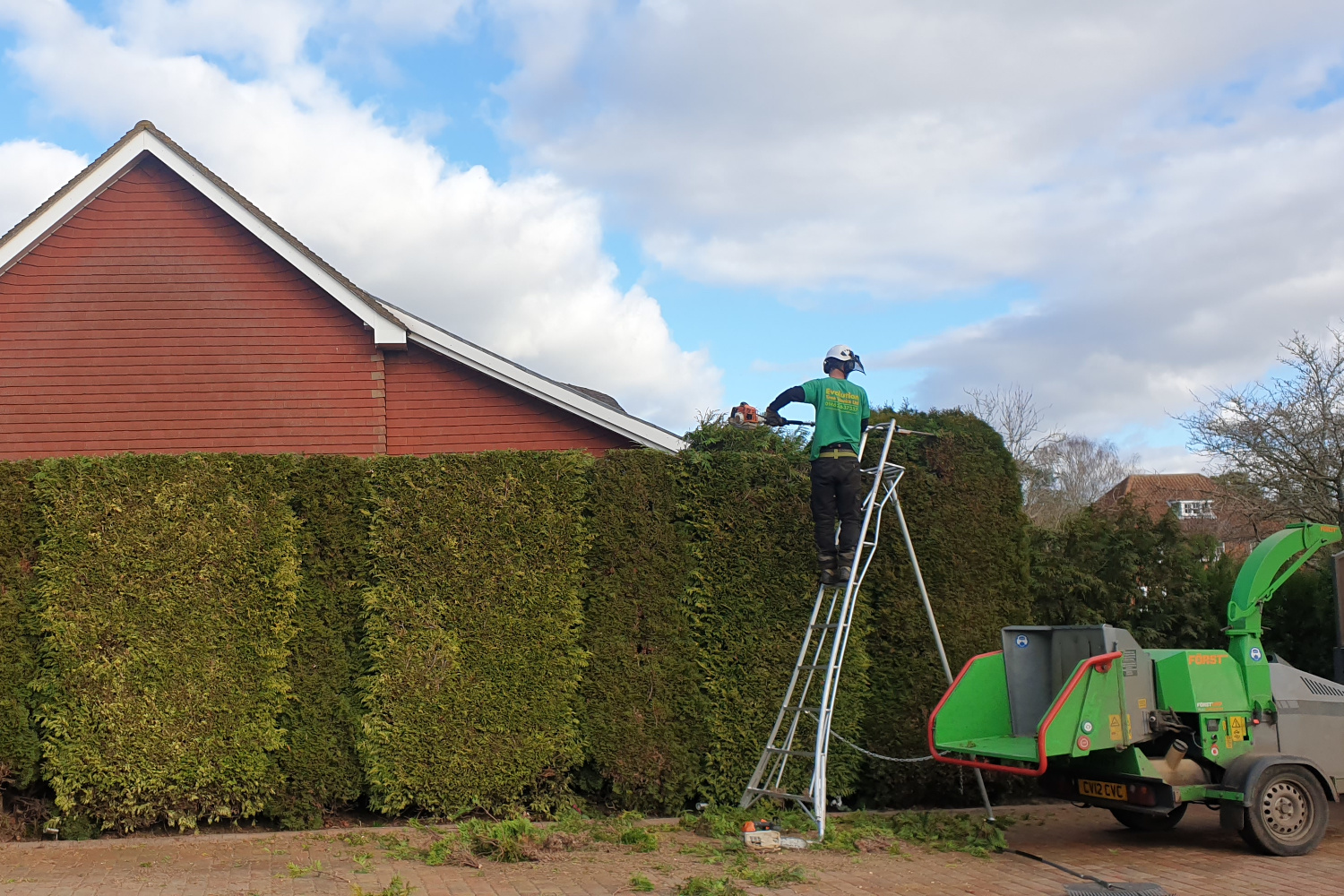
    Large hedge cutting can involve working at height and using powerful cutting equipment, often beside fences, buildings, roads or neighbouring properties. Different hedge species also respond very differently to heavy pruning. Evolution Tree Works provides professional hedge cutting and hedge trimming in Langford, Bedfordshire, taking the condition and growth  haracteristics of the hedge into account. From small residential hedges to substantial commercial boundaries, we can recommend an appropriate level of maintenance and carry out the work safely and efficiently.


    Hedge Waste & Site Clearance


    Cutting a large hedge can produce a considerable volume of branches and foliage. Once the agreed work has been completed, hedge cuttings can be processed and removed so that you are not left with the task of disposing of large quantities of green waste yourself.


    Our aim is to leave both the hedge and the surrounding working area neat and tidy.

    .

    Can a Very Overgrown Hedge Be Restored?


    Often it can, but the answer depends on what the hedge is made from. Some species tolerate substantial renovation and can produce new growth from older stems. Others need to retain green foliage and cannot simply be cut back to the desired dimensions in one operation. For particularly overgrown hedges, a staged reduction may sometimes provide a better result. Our team can assess the species and condition before recommending how the hedge should be managed.

    Should I Reduce or Remove an Old Hedge?


    An overgrown hedge does not necessarily need to be removed. If the plants remain healthy and the hedge still provides useful privacy or screening, renovation may allow it to continue serving its purpose for many years. Removal may be more appropriate where the hedge has deteriorated badly, contains substantial gaps or is fundamentally unsuitable for its location. Where an old hedge is removed, replacement planting provides an opportunity to choose species better suited to the available space and the amount of future maintenance you want.


  • Style: Lime
  • Extra Block Three (Left):

    Areas We Cover Around Langford


    Our hedge trimming services are available throughout:


    Need Hedge Trimming services in Langford?


    If your hedge is becoming too tall, too wide or simply needs tidying, contact Evolution Tree Works on 01462 637 357 or use the link below to get in touch.


    Get in Touch

  • Extra Block Three (Right):
  • Style: Image
  • Image:


Professional Hedge Trimming in Langford, Bedfordshire


Hedges are an attractive and practical feature of many gardens, providing privacy, screening, shelter and clearly defined boundaries. Left unmanaged, however, a healthy hedge can quickly become wider and taller than intended. Evolution Tree Works provides professional hedge trimming in Langford, Bedfordshire, from routine cutting and shaping to the reduction of large and overgrown hedges.


We work with homeowners, landlords, businesses and property managers, tailoring the work to the species, condition and size of each hedge. Whether you want to maintain a neat formal hedge, reclaim space from an overgrown boundary or reduce the height of a large established hedge, our experienced team can advise on an appropriate approach.

Hedge Trimming


Hedge Cutting & Regular Maintenance


Regular hedge cutting is generally the easiest way to keep an established hedge at a manageable size. Rather than allowing several years of growth to accumulate before carrying out a major reduction, periodic trimming can maintain the desired height and width while encouraging dense growth.


How frequently a hedge requires attention depends on the species and the style you want to maintain. Fast-growing and formal hedges may require more frequent trimming, while slower-growing or informal hedges can often be maintained on a less intensive schedule. 


Evolution Tree Works provides hedge maintenance in Langford tailored to the individual hedge rather than applying the same cutting regime to every property.

Overgrown Hedge Reduction


An established hedge can gradually become much larger than expected. It may begin to encroach across a lawn, narrow a driveway, block a path, obscure windows or extend significantly into a neighbouring property. Professional hedge reduction can help bring this growth back under control. The amount that can safely be removed depends heavily on the species.


Some hedges respond well to substantial renovation and can regenerate from older wood. Others can be permanently damaged if they are cut back beyond their healthy foliage. Before carrying out a severe reduction, it is therefore important to understand how the particular hedge is likely to respond.


Hedge Height Reduction in Langford


Tall hedges can provide excellent privacy but may eventually become difficult to maintain. They can also create excessive shade or begin to dominate smaller gardens. Hedge height reduction in Langford can bring an established hedge back to a more manageable level while retaining its screening function where possible.


For very large hedges, the best approach may depend on how much living foliage would remain after the reduction. Once the required height has been established, regular maintenance can help prevent the hedge gradually returning to its previous dimensions.

Hedges for Privacy & Screening


Privacy is one of the main reasons homeowners choose hedging rather than a conventional fence. A dense hedge can soften the appearance of a boundary while providing natural screening between neighbouring gardens or between a property and the road. Good hedge maintenance aims to control size without unnecessarily sacrificing that screening.


Regular trimming can encourage dense growth and help prevent a hedge becoming excessively wide. If you are considering creating additional natural screening rather than simply maintaining an existing hedge, our tree planting services in Langford can also help with the selection of appropriate trees for privacy.


Boundary Hedge Trimming


Boundary hedges often need to perform several jobs at once. They may provide privacy, mark the edge of a property and contribute significantly to the appearance of both the garden and surrounding street. As they grow, however, branches can begin to extend across neighbouring land, pavements, driveways and other access routes. Routine trimming helps maintain a defined boundary while preventing the hedge gradually occupying more space each year. For larger boundary hedges, professional equipment also allows the top and sides to be maintained more safely and consistently.


Conifer Hedge Cutting


Conifers are popular hedging plants because many varieties provide dense evergreen screening. Their vigorous growth can also make regular maintenance particularly important. Some commonly used conifers do not regenerate successfully when cut back into old brown wood. Allowing a conifer hedge to become substantially wider than required and then attempting a severe reduction can therefore leave permanent bare areas. Regular trimming of the green growth is usually a much better way to control its dimensions. If your conifer hedge has already become very large, Evolution Tree Works can assess how much reduction is practical.

Laurel Hedge Trimming


Laurel can create an effective evergreen boundary and is capable of producing vigorous growth once established. Without regular trimming, a laurel hedge can become both tall and exceptionally wide. Fortunately, established laurel can often respond well to appropriate pruning. Whether the hedge requires routine trimming or more substantial renovation will depend on its condition and the amount by which you want to reduce it. Once an overgrown hedge has been brought back to a suitable size, ongoing maintenance can help retain its shape and prevent the same problem developing again.

Formal Hedge Cutting


Formal hedges are maintained to create clearly defined lines and an even appearance. They can work particularly well beside entrances, paths, driveways and more structured garden designs. Maintaining this appearance generally requires more frequent attention than an informal hedge. Regular light trimming can help preserve the shape without repeatedly removing large amounts of growth. Evolution Tree Works can maintain formal hedging at domestic and commercial properties throughout Langford.


Maintaining Natural & Informal Hedges


Not every hedge needs perfectly straight sides and a flat top. Mixed and informal hedges can provide a softer, more natural boundary and may have particular value for wildlife. Maintenance can focus on controlling excessive growth and keeping the hedge appropriate for its location while preserving more of its natural character. The style of cutting should therefore reflect both the hedge species and the landscape in which it is growing.


Clearing Paths & Driveways


Hedges beside driveways and paths can gradually reduce the amount of usable space available. This may happen so slowly that the extent of the encroachment only becomes obvious when the hedge is eventually cut back. Overhanging vegetation can also reduce visibility around entrances and junctions. Appropriate side trimming can restore clearance while retaining the hedge itself. For large commercial properties, maintaining hedges around entrances, parking areas and pedestrian routes can also form an important part of routine grounds management.

Hedge Trimming Near Roads & Pavements


Where hedges grow beside roads and public footways, unmanaged growth can become more than an aesthetic issue. Branches may narrow the available pavement, obstruct visibility or make access more difficult. Regular maintenance helps keep vegetation within an appropriate boundary. Large roadside hedges can present additional practical challenges because work needs to take account of both the hedge itself and the surrounding area. Evolution Tree Works can assess the site and determine an appropriate method of carrying out the required work.

Hedge Cutting & Nesting Birds


Hedges provide important nesting and feeding habitat for many birds. This needs to be considered when planning hedge work. Active wild bird nests are legally protected, so hedges should be checked before cutting where nesting birds may be present. Where circumstances permit, more substantial reductions can be planned for a time that minimises disturbance to wildlife. If an active nest is discovered, work affecting it may need to be postponed until it is no longer in use.


Commercial Hedge Trimming


Evolution Tree Works provides commercial hedge trimming in Langford for businesses, landlords, property managers and other organisations. Well-maintained hedging can make an important contribution to the appearance of commercial premises while providing practical boundaries and screening.


Our commercial hedge services can include:


  • Routine hedge cutting
  • Height reduction & Side trimming
  • Overgrown hedge renovation
  • Clearance around entrances and paths
  • Boundary hedge maintenance
  • Management of hedges around car parks and access roads


Hedge work can also be incorporated into wider commercial tree services in Langford where trees and hedges across a property require ongoing management.

Why Maintain Hedges Regularly?


Routine maintenance can prevent many of the problems associated with mature hedges.


Regular trimming can help:


  • Maintain a manageable height
  • Control the width of the hedge
  • Preserve privacy and screening
  • Encourage dense growth
  • Keep paths and driveways clear
  • Maintain visibility around entrances
  • Prevent a hedge overwhelming a smaller garden
  • Reduce the need for severe future pruning


A little regular maintenance can often achieve a much better result than allowing a hedge to become excessively large before dealing with it.


Professional Hedge Trimming in Langford


Large hedge cutting can involve working at height and using powerful cutting equipment, often beside fences, buildings, roads or neighbouring properties. Different hedge species also respond very differently to heavy pruning. Evolution Tree Works provides professional hedge cutting and hedge trimming in Langford, Bedfordshire, taking the condition and growth  haracteristics of the hedge into account. From small residential hedges to substantial commercial boundaries, we can recommend an appropriate level of maintenance and carry out the work safely and efficiently.


Hedge Waste & Site Clearance


Cutting a large hedge can produce a considerable volume of branches and foliage. Once the agreed work has been completed, hedge cuttings can be processed and removed so that you are not left with the task of disposing of large quantities of green waste yourself.


Our aim is to leave both the hedge and the surrounding working area neat and tidy.

.

Can a Very Overgrown Hedge Be Restored?


Often it can, but the answer depends on what the hedge is made from. Some species tolerate substantial renovation and can produce new growth from older stems. Others need to retain green foliage and cannot simply be cut back to the desired dimensions in one operation. For particularly overgrown hedges, a staged reduction may sometimes provide a better result. Our team can assess the species and condition before recommending how the hedge should be managed.

Should I Reduce or Remove an Old Hedge?


An overgrown hedge does not necessarily need to be removed. If the plants remain healthy and the hedge still provides useful privacy or screening, renovation may allow it to continue serving its purpose for many years. Removal may be more appropriate where the hedge has deteriorated badly, contains substantial gaps or is fundamentally unsuitable for its location. Where an old hedge is removed, replacement planting provides an opportunity to choose species better suited to the available space and the amount of future maintenance you want.


Areas We Cover Around Langford


Our hedge trimming services are available throughout:


Need Hedge Trimming services in Langford?


If your hedge is becoming too tall, too wide or simply needs tidying, contact Evolution Tree Works on 01462 637 357 or use the link below to get in touch.


Get in Touch


Frequently Asked Questions


It depends on the species, growth rate and the appearance you want to maintain. Formal and vigorous hedges may require more than one trim during the growing season, while slower-growing or informal hedges may need less frequent maintenance.

Yes, in many cases. The amount of reduction that can be carried out safely depends on the species and condition of the hedge. Some hedges tolerate substantial renovation while others should not be cut back beyond healthy green growth.

Care is needed with many conifers because they may not regenerate from old brown wood. A severely overgrown conifer hedge should be assessed before substantial cutting takes place.

The best time depends on the species and type of work required. Nesting birds must also be considered, and work should not disturb active nests. More substantial reductions can often be planned outside the main nesting period where practical.

Yes, hedge trimmings can be processed and removed as part of the agreed work, leaving the surrounding area tidy once the job has been completed.